 EN
EN
 INA
INA
Exploratory Collaboration Visit and Donation of Gembrong Goats to the Bali Wildlife Rescue Center
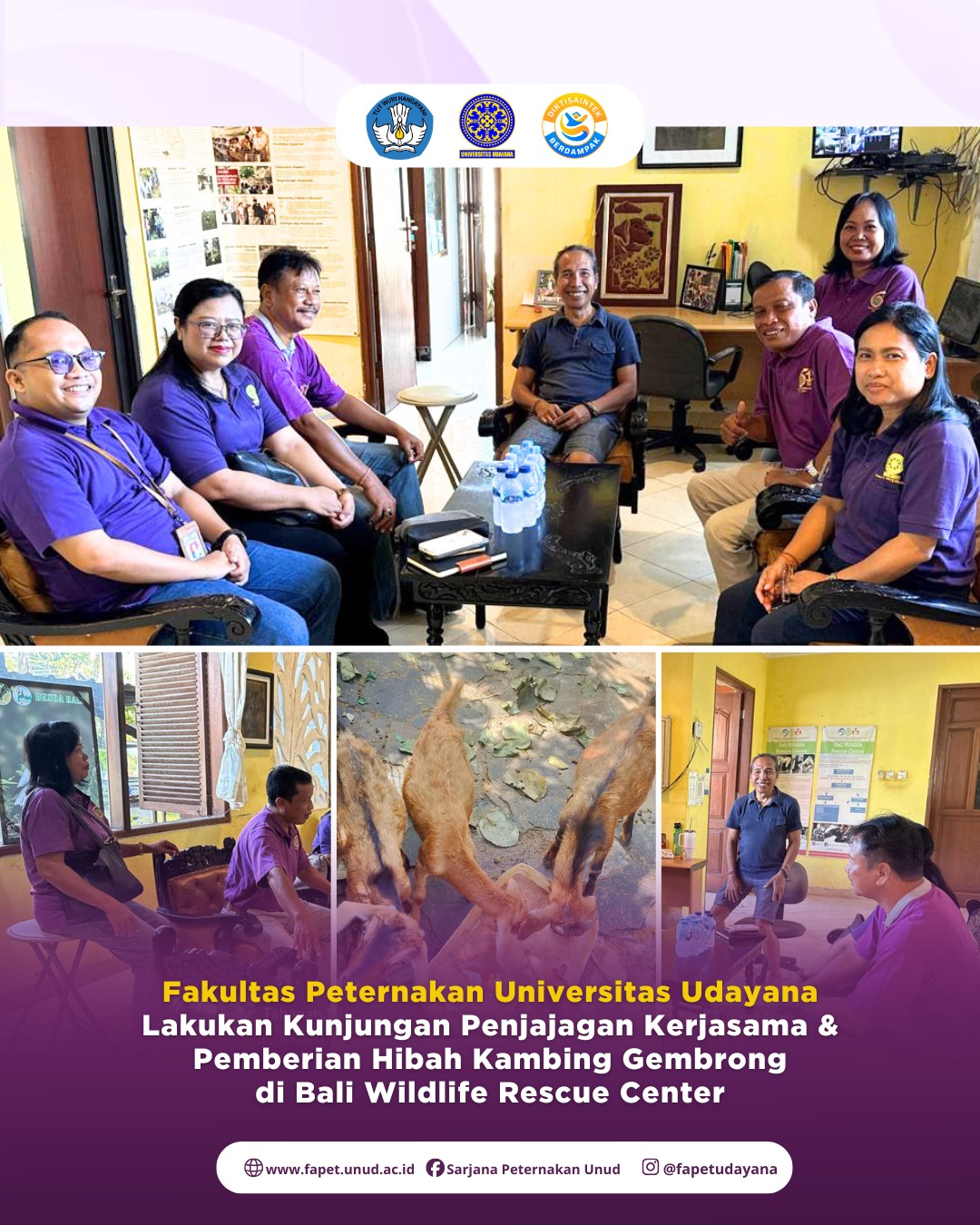
Tabanan, 1 April 2026 — The Faculty of Animal Husbandry, Udayana University, conducted an “Exploratory Collaboration Visit and Donation of Gembrong Goats” at the Bali Wildlife Rescue Center, Dukuh, Tabanan. This activity represented a strategic initiative to strengthen collaboration between an academic institution and a wildlife conservation organization, particularly in efforts to preserve Bali’s indigenous livestock genetic resources.
The visit was attended by the leadership of the Faculty of Animal Husbandry, including the Vice Dean for Academic Affairs and Planning, Dr. Ir. I Gede Suarta, M.Si.; the Vice Dean for General Affairs and Finance, Dr. Ir. Budi Rahayu Tanama Putri, S.Pt., M.M., IPU., ASEAN Eng., APEC Eng.; and the Vice Dean for Student Affairs, Dr. I Nyoman Sumerta Miwada, S.Pt., M.P. Also in attendance were Dr. Ir. Eny Puspani, S.Pt., M.Si., IPU., Coordinator of the Information and Cooperation Management Unit, and Moh. Ihsan Zain, S.Pt., M.Sc., Head of the Bukit Jimbaran Farm.
The primary objective of the visit was to explore opportunities for collaboration in the conservation, development, and utilization of local livestock resources, particularly the Gembrong goat, one of Bali’s indigenous genetic resources with significant genetic, cultural, and historical value. On this occasion, a number of Gembrong goats were officially donated as a tangible contribution from the Faculty of Animal Husbandry, Udayana University, to support conservation and breeding efforts at the Bali Wildlife Rescue Center.
Through this initiative, both institutions are expected to establish sustainable collaboration in the areas of education, research, and community service, particularly concerning the conservation of local livestock genetic resources. Furthermore, the partnership is expected to provide valuable learning opportunities for students by exposing them to practical aspects of livestock conservation and management in a real-world setting.
The activity was conducted successfully and with great enthusiasm, concluding with a productive discussion on potential follow-up programs and future collaborative initiatives between the two institutions.
UDAYANA UNIVERSITY